
Most pediatricians say a baby can have a loose blanket in the crib around 12 months old, once they can roll over independently in both directions, pull a blanket off their own face, and no longer meet the criteria for SIDS risk from loose bedding. Before that age, the AAP recommends a sleep sack or wearable blanket instead of loose bedding of any kind. This guide covers the three questions new parents ask most about safe sleep — blankets, stomach sleeping, and how long a baby should stay in your room — with clear, age-based answers based on current American Academy of Pediatrics (AAP) guidance.
When Can a Baby Sleep With a Blanket?
A baby is generally considered ready for a loose blanket around their first birthday, once they can roll both ways on their own and move away from or push off anything covering their face. Until 12 months, the AAP recommends keeping the crib completely bare — no loose blankets, pillows, bumpers, stuffed animals, or weighted blankets — because loose bedding is one of the leading preventable risk factors for Sudden Infant Death Syndrome (SIDS) and accidental suffocation. Instead of a blanket, pediatricians recommend:
- A wearable blanket or sleep sack — zips or wraps around the baby with no loose fabric near the face, safe from birth
- Footed sleepers or layered pajamas for extra warmth without any loose fabric in the crib
- Room temperature management (68-72°F / 20-22°C) rather than extra bedding to keep baby comfortable
Signs your baby may be ready for a light, breathable blanket around 12 months include consistently rolling both front-to-back and back-to-front on their own, having the strength to push bedding away from their face, and your pediatrician confirming there’s no other risk factor specific to your baby. Even after 12 months, many parents choose to continue with a sleep sack through the toddler years simply because it’s safer and no fussing with a blanket that gets kicked off.
When Can a Baby Sleep on Their Stomach?
Every baby should be placed on their back for every single sleep, including naps, until their first birthday — but once a baby can roll over on their own in both directions (usually between 4 and 6 months), it’s safe to leave them in whatever position they land in, including on their stomach. This is often called the “back to sleep, roll to stomach” rule, and it’s one of the most frequently misunderstood pieces of safe sleep guidance. The key distinction pediatricians make is between how you place your baby and what happens after:
- Always place baby on their back to start every sleep period, with no exceptions, from birth through 12 months
- Once a baby can roll both ways independently (back-to-stomach and stomach-to-back), you do not need to flip them back if they roll onto their stomach during sleep
- If your baby can only roll one direction (for example, stomach-to-back but not back-to-stomach), gently reposition them onto their back if you find them on their stomach, since they may not yet be able to get out of a position that restricts airflow
- Tummy time while awake and supervised is different from sleep positioning and is recommended daily from birth to build the neck and shoulder strength babies need to roll safely — see our tummy time by age guide for how much your baby needs at each stage
Most babies reach the rolling-both-ways milestone somewhere in the 4 to 6 month window, though some do so earlier or later — your baby’s own developmental pace matters more than a strict calendar age. If you’re unsure whether your baby has reliably mastered rolling both directions, continue placing them on their back and ask your pediatrician at the next well-baby visit.
How Long Should a Baby Sleep in Your Room?
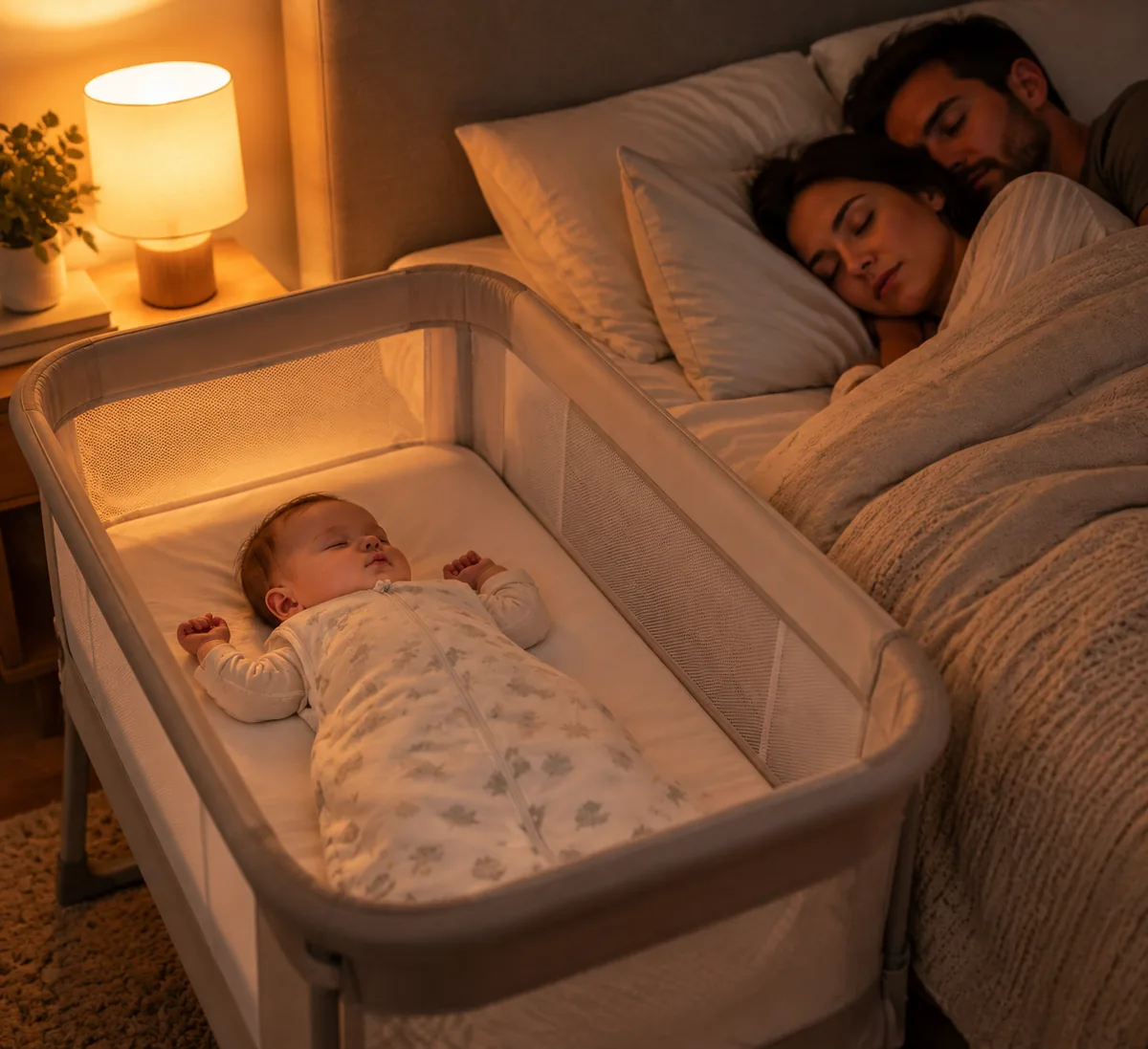
The AAP recommends room-sharing (baby sleeping in your room, on a separate sleep surface) for at least the first 6 months, and ideally up to 12 months, because room-sharing without bed-sharing is associated with up to a 50% reduction in SIDS risk. This recommendation is specifically about sharing a room, not a bed — the AAP does not recommend bed-sharing under any circumstances, including with a smoker, or if a parent is impaired by alcohol, sedating medication, or extreme exhaustion. A safe room-sharing setup looks like:
- A separate, firm sleep surface (crib, bassinet, or play yard) positioned close to the parents’ bed
- No pillows, blankets, bumpers, or soft bedding on that surface, following the same bare-crib rule described above
- The sleep surface at the same level as or lower than the parents’ bed, with no gaps where a baby could become trapped
Roughly 90% of SIDS cases occur before 6 months of age, which is the main reason the recommended window runs through at least the half-year mark. Many families choose to continue room-sharing through 12 months for convenience with night feeds, while others transition the baby to their own room closer to 6 months — both are considered safe as long as the sleep surface itself continues to follow safe sleep practices in either location.
Why These Three Rules Matter So Much
SIDS remains the leading cause of death for babies between 1 month and 1 year old in the United States, and the back-sleeping, bare-crib, and room-sharing recommendations exist specifically because large population studies tied each one to a measurable drop in risk. When the “Back to Sleep” campaign launched in the early 1990s, SIDS rates fell by more than 50% within just a few years — one of the most dramatic public health successes tied to a single behavior change. Understanding the “why” behind each rule tends to help parents stick with them even when a fussy baby makes compliance harder in the moment:
- Back sleeping keeps the airway in the most open, least obstructable position and reduces the chance of rebreathing exhaled air trapped near the face
- A bare sleep surface removes the physical objects most commonly found in a baby’s airway or over the face in SIDS case reviews — pillows, loose blankets, and crib bumpers rank among the most frequently implicated items
- Room-sharing is thought to work partly because a sleeping parent nearby subtly influences a baby’s own sleep arousal patterns, and partly because it makes a parent more likely to notice if something is wrong
None of these rules eliminate risk entirely — SIDS is not fully understood and likely involves a combination of a vulnerable developmental window, an underlying predisposition, and an external stressor — but each has strong population-level evidence behind it, which is why pediatric organizations worldwide converge on similar guidance.
Common Safe Sleep Mistakes Parents Make Without Realizing It
Most safe sleep lapses happen unintentionally, often during a particularly tired night or a well-meaning gift from a relative, rather than from ignoring the guidelines outright. The most common ones worth double-checking in your own setup include:
- Crib bumpers — still sold and gifted widely despite AAP guidance against them, because they were considered safe decades ago; even “breathable mesh” bumpers are generally discouraged
- Falling asleep together on a couch or armchair while feeding — this combination is considered higher-risk than either bed-sharing or a crib alone, because soft cushions and the risk of a parent not waking up create a particularly dangerous surface
- Positioners and wedges marketed to “keep baby on their back” — the FDA has specifically warned against these products due to suffocation reports, since they can trap a baby against soft material if they shift position
- Swaddling after a baby starts attempting to roll — a swaddled baby who rolls onto their stomach can’t use their arms to reposition or lift their head, which is why swaddling should stop once rolling attempts begin, typically around 2-4 months
- Letting a baby sleep in a car seat, swing, or stroller for extended periods — these are fine for supervised, awake transport but are not designed as a primary sleep surface, since the semi-upright angle can affect airway position
- Overdressing “just in case” — overheating is itself an independent SIDS risk factor, so more layers are not automatically safer
Putting It All Together: A Safe Sleep Checklist
A baby’s sleep space is safest when every element of these three guidelines is followed together, not just one in isolation. Use this as a quick reference:
- Back to sleep for every nap and night sleep until baby reliably rolls both directions
- A bare crib or bassinet — no blankets, pillows, bumpers, or stuffed animals before 12 months
- A sleep sack or wearable blanket instead of loose bedding for warmth
- Room-sharing (not bed-sharing) for at least 6 months, ideally up to 12 months
- A firm, flat sleep surface with a fitted sheet and nothing else
- No smoke exposure, and a room temperature that avoids overheating
If you’re tracking naps and night sleep as your baby’s patterns change month to month, our sleep tracker can help you log totals and spot trends, and our nap and wake window calculator can help with scheduling once your baby is sleeping safely and consistently.
Frequently Asked Questions
Is it ever okay to use a thin blanket before 12 months if I supervise closely?
Current AAP guidance doesn’t make an exception for supervised use, because unattended sleep — including naps where a parent steps away — is when the risk exists. A sleep sack provides the warmth without needing to supervise against loose bedding.
My baby rolls onto their stomach but can’t roll back yet — what should I do?
Continue placing your baby on their back to start sleep, and if you find them on their stomach and they can’t yet roll back on their own, gently reposition them onto their back. Once they reliably master both directions, you can leave them in whichever position they land in.
Does room-sharing mean the baby has to be in a crib right next to the bed?
It means baby sleeps in the same room as the parents on their own separate, firm sleep surface — a bassinet, crib, or play yard positioned nearby, not sharing the parents’ mattress.
What if my baby seems cold without a blanket?
A well-fitted sleep sack rated for your room’s temperature, combined with appropriate pajamas, keeps most babies comfortably warm without the suffocation risk of loose blankets. As a general check, a baby who feels warm at the chest or back of the neck (not cold hands, which are normal) is usually dressed appropriately.
When should I move my baby to their own room?
Any time after 6 months is considered safe by AAP guidance, and many families wait until closer to 12 months. The right timing depends on your family’s sleep needs, your baby’s sleep patterns, and your own comfort level — there’s no single correct age beyond the 6-month minimum.
Are weighted sleep sacks or weighted swaddles safe?
No — weighted sleep products are specifically advised against in current AAP guidance, despite marketing claims that the added weight calms babies similarly to swaddling or a parent’s touch. There isn’t enough safety research on weighted products for infant sleep, and regular (non-weighted) sleep sacks achieve the same warmth and containment benefits with an established safety record.
Is it safe to use a video or audio baby monitor instead of room-sharing?
A monitor is a helpful addition but is not considered a substitute for room-sharing in current guidance, since the protective effect is tied to proximity and arousal patterns, not simply the ability to see or hear the baby remotely. Many families use both — room-sharing for the first 6-12 months, plus a monitor for added reassurance once the baby transitions to their own room.
What should I do if my older child or pet sometimes ends up in the baby’s sleep space?
The same bare-sleep-surface rule applies regardless of what or who ends up near the crib — stuffed animals, pet bedding, or anything soft should be kept out of the baby’s dedicated sleep surface entirely, and older siblings should be supervised around the crib rather than allowed to place items inside it.
This article is for general informational purposes and is not a substitute for professional medical advice. Always discuss your baby’s specific sleep setup with your pediatrician.